
Closed-Loop Stepper vs Servo vs Open-Loop Stepper: The Real Gap and Selection Boundaries
A closed-loop stepper "gives the stepper eyes," while a servo "gives the motor eyes and a cerebellum." The former solves the lost-steps-without-anyone-knowing problem; the latter solves the dynamic response and overload problem. Once you separate these two things, the question "can a closed-loop stepper replace a servo" answers itself.
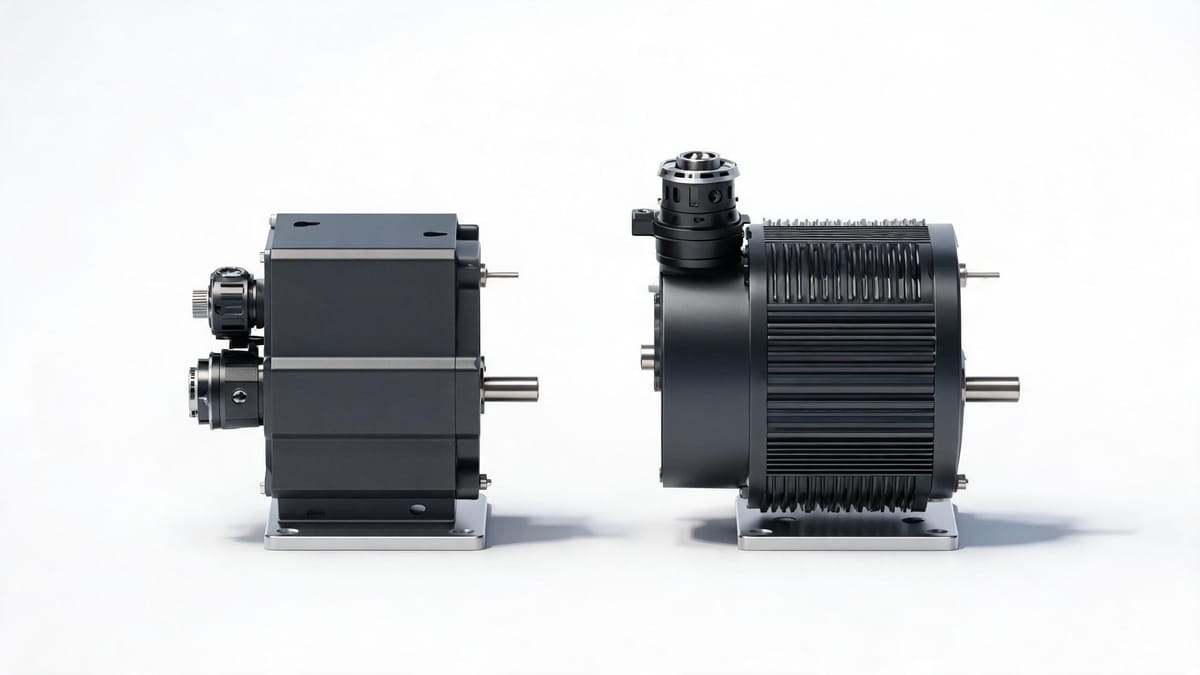
Figure: Closed-loop stepper motor (left) vs servo motor (right) — differences in feedback device and dynamic capability
1. Where Exactly Do the Three Differ: One Table to Understand
Dimension | Open-Loop Stepper | Closed-Loop Stepper | Servo Motor |
|---|---|---|---|
Feedback device | None | Rear encoder | High-resolution encoder (17–23 bit+) |
Control method | Open-loop, pulse counting | Position deviation detection + current/pulse compensation | Three-loop closed loop (current/velocity/position) |
Lost-step behavior | Silent lost steps, system unaware | Position-deviation alarm, or automatic correction | No lost steps; deviation is continuously corrected |
Overload capability | None | Limited (about 1.5×, short-time) | 2–3× rated torque |
Torque-speed characteristics | Decays rapidly with speed | Same as left (physics unchanged) | Constant torque within rated speed |
High-speed performance | Poor (generally < 1000 rpm) | Slightly better, still significantly weaker than servo | Good (commonly 3000 rpm+) |
Low-speed smoothness | Stepping sensation, prone to resonance | Clearly improved | Extremely smooth |
Heat | High (continuous rated current) | Low (current on demand) | Low (current on demand) |
Noise | Relatively high | Relatively low | Lowest |
Cost | Low (baseline 1×) | Medium (about 1.5–2×) | High (about 2–4×) |
Tuning difficulty | Extremely low | Low | Medium (most auto-tune) |
2. What Is a Closed-Loop Stepper? How Is Closed-Loop Achieved?
Principle
The fatal flaw of a traditional open-loop stepper is: the driver only sends pulses and assumes the motor has reached the position. Once the load changes suddenly, acceleration is too high, or the motor falls into a resonance zone, the rotor cannot keep up with the magnetic field and loses steps — while the controller has no idea.
The closed-loop stepper's solution: add an encoder to the stepper's rear; the driver compares the "commanded position" with the "feedback position" in real time.
Three-Step Closed-Loop Logic
Real-time monitoring: the encoder continuously reports the actual position, and the driver calculates the deviation between commanded and actual positions;
Threshold judgment: deviation within the allowable range → normal operation; deviation exceeds the threshold → enter the handling process;
Deviation handling:
Conservative strategy: report a position-deviation alarm and stop (avoid continuing to produce scrap);
Aggressive strategy: automatically increase winding current or send compensation pulses to correct the deviation and keep running if possible.
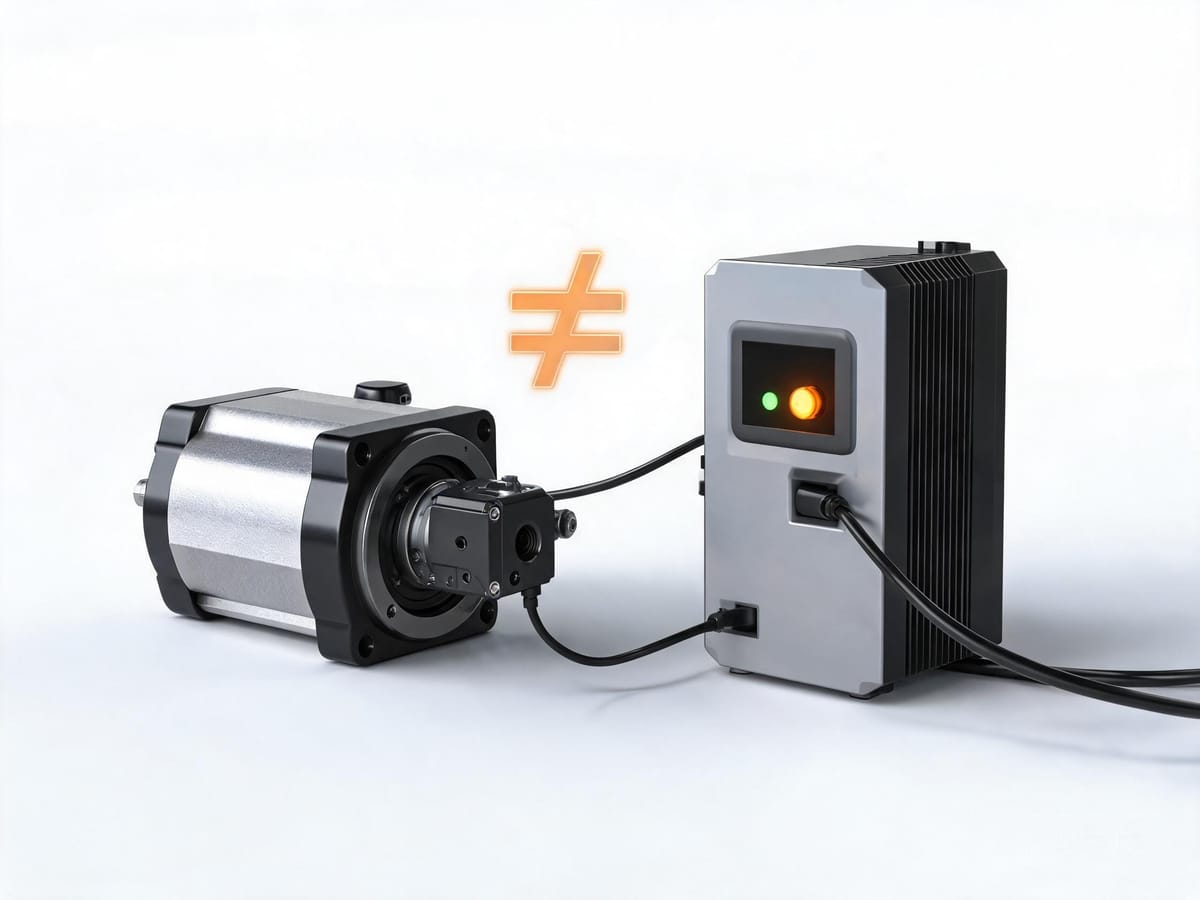
Figure: Closed-loop stepper motor — the rear encoder reports position in real time, and the driver judges the deviation by threshold and alarms or corrects
Three Additional Benefits of Closed-Loop (Often Underestimated)
① Significantly lower heat
This is the most underestimated advantage of the closed-loop stepper. To "ensure no lost steps," an open-loop stepper must be powered at rated current the whole time, running at full current even when stationary and locked. A closed-loop stepper only supplies current when torque output is needed — continuous-running temperature can drop by 30–50%.
This directly brings:
Longer motor life;
Lower temperature rise inside the enclosure (significant for medical equipment and sealed devices);
Allows smaller heat-dissipation design.
② Can tolerate transient overload
A transient impact does not immediately cause lost steps; the system has a certain "tolerance window."
③ Faults are perceivable
The equipment changes from "silently making mistakes" to "alarming in time," which often affects mass-production yield and after-sales costs far more than the motor price difference itself.
Three Things a Closed-Loop Stepper Cannot Change
This must be stated clearly to avoid selection pitfalls:
Torque-speed characteristics unchanged — the torque decay caused by winding inductance back-EMF is a physical law; adding an encoder cannot solve it;
Overload capability remains limited — the stepper's magnetic circuit design determines that it does not have the servo's short-time large overload margin;
Very-low-speed stepping sensation and medium-speed resonance — closed-loop can improve but cannot eliminate them, because the root cause is the motor's discrete stepping structure.
3. Why the Servo Motor Is Still the Strongest Solution
The servo's advantage is not "more accurate" (a closed-loop stepper can also be very accurate), but dynamic performance:
1. High Bandwidth from Three-Loop Closed Loop
Inside a servo driver are three nested loops — current, velocity, and position — with the bandwidth hierarchy:
Current loop (10–20 kHz) > velocity loop (2–5 kHz) > position loop (1–2 kHz)
This means a servo can respond to load disturbances within milliseconds. A closed-loop stepper has only a position loop, with no fine velocity-loop or torque-loop regulation in between, so its response to varying loads is noticeably sluggish.
2. 2–3× Short-Time Overload
Servo motors generally have 2–3× rated torque short-time overload capability, used to overcome starting inertia, mechanical shock, and instantaneous cutting forces. This capability is not available in any stepper solution (including closed-loop).
3. Constant Torque Within Rated Speed
A stepper's torque slides downward from 600 rpm onward, while a servo's torque is a horizontal line within 3000 rpm (rated speed). This difference determines that the two have completely different applicable speed ranges.
4. The Generation Gap in Encoder Resolution
Typical Resolution | |
|---|---|
Closed-loop stepper | About 14-bit (16384 positions/rev) is already high-end |
Servo | 17-bit (131072) as a starting point; 20–23 bit is now common |
Higher resolution not only means finer positioning, but also means the velocity loop can obtain smoother velocity feedback, supporting higher gain and faster response.
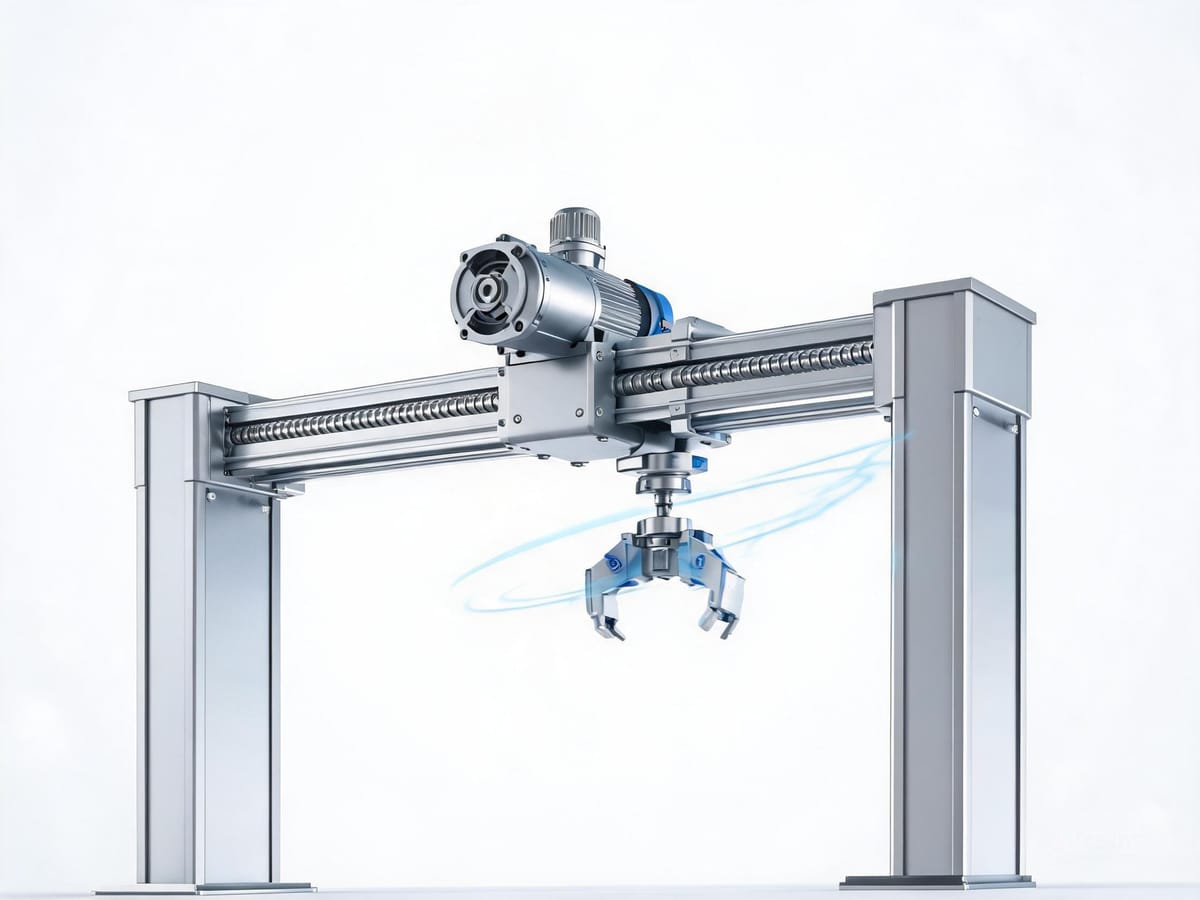
Figure: High-dynamic servo motor — millisecond response and 2–3× short-time overload support high-speed high-precision positioning
4. Can a Closed-Loop Stepper Replace a Servo? — Clear Boundaries
✅ Situations Where a Closed-Loop Stepper Can Replace a Servo
Condition | Reason |
|---|---|
Speed < 800 rpm | Stepper torque decay is not yet a bottleneck |
Stable load, no impact | No overload capability needed |
No sustained external force disturbance after positioning | The position loop is sufficient |
Cost-sensitive but silent lost steps not allowed | The core value of closed-loop |
Poor heat dissipation / sealed enclosure | The low-heat advantage of closed-loop |
Many axes, limited space | The size advantage of integrated closed-loop steppers is obvious |
Typical equipment: medical analyzers, syringe pumps, dispensers, small SMT machines, vision measuring machines, automatic wire feeders, 3D printers, smart kitchen appliances.
❌ Situations Where a Closed-Loop Stepper Cannot Replace a Servo
Condition | Reason |
|---|---|
Speed > 1500 rpm with sustained load | Stepper torque has severely decayed |
Needs more than 2× transient overload | The stepper magnetic circuit has no such margin |
Extremely short positioning time (< 100 ms) high-dynamic reciprocation | Insufficient stepper acceleration/deceleration capability |
Multi-axis high-precision synchronized interpolation (flying shear, rotary cut, electronic cam) | Needs EtherCAT-level synchronization and high bandwidth |
Load inertia ratio > 10:1 | Stepper tuning tools are limited; no notch filter, etc. |
Varying load, varying inertia conditions | Stepper cannot identify and adapt online |
Typical equipment: CNC feed axes, robot joints, packaging flying shears, printing registration, high-speed pick & place.
5. Cost Comparison: Count the Total, Not the Unit Price
Looking only at the motor unit price leads to wrong conclusions. The real comparison should be total cost of ownership (TCO):
Cost Item | Open-Loop Stepper | Closed-Loop Stepper | Separate Servo | Integrated Servo |
|---|---|---|---|---|
Motor | 1× | 1.5× | 2× | 2.5× |
Driver | Included (small) | Included (medium) | Must be purchased, 60–100% of motor cost | Integrated |
Encoder cable | None | Integrated | Needs shielded cable, a major cost in multi-axis systems | None (integrated) |
Cabinet space | Small | Small | Large (needs driver mounting) | Extremely small |
Wiring labor | Low | Low | High | Extremely low |
Tuning labor | Extremely low | Low | Medium–high | Low |
Heat-dissipation design | Needs consideration | Basically not needed | Needs consideration | Needs consideration |
Key insight: in multi-axis systems (≥ 4 axes), the encoder cables, driver cabinet space, and wiring labor of separate servos quickly eat up the motor price difference. In this case, an integrated servo (drive-in-one + bus networking) is often the better total-cost solution.
6. Limaisheng NiMotion's Three-Tier Solutions
Series | Type | Encoder | Communication | Typical Applications |
|---|---|---|---|---|
STM (open-loop) | Integrated stepper motor | None | CANopen / RS485 | 3D printing, small conveyors, valves |
STM (closed-loop) | Integrated stepper servo motor | Integrated 14-bit absolute encoder | CANopen / RS485 | Medical equipment, analyzers, dispensers, AGVs |
PMM / PSM | Integrated AC servo motor | Integrated 2500-line encoder (multi-turn absolute optional) | CANopen / RS485 / EtherCAT | Robot joints, precision positioning, high-speed reciprocation |
BLM | Integrated brushless DC motor | Integrated 2500-line encoder | CANopen / RS485 | Inspection robot gimbals, capping machines, filling |
The STM closed-loop series supports the full CiA 402 motion modes, including:
PP Profile Position mode
PV Profile Velocity mode
VM Velocity mode
IP Interpolated Position mode
HM Homing mode (switch homing)
CSP Cyclic Synchronous Position mode
CSV Cyclic Synchronous Velocity mode
It uses FOC field-oriented control + SVPWM drive; running current and idle current can be set separately (0–1.5A adjustable); it supports overcurrent protection (max 3A), power overvoltage/undervoltage alarm, over-temperature alarm, and stall alarm, with power-loss protection implemented via EEPROM.
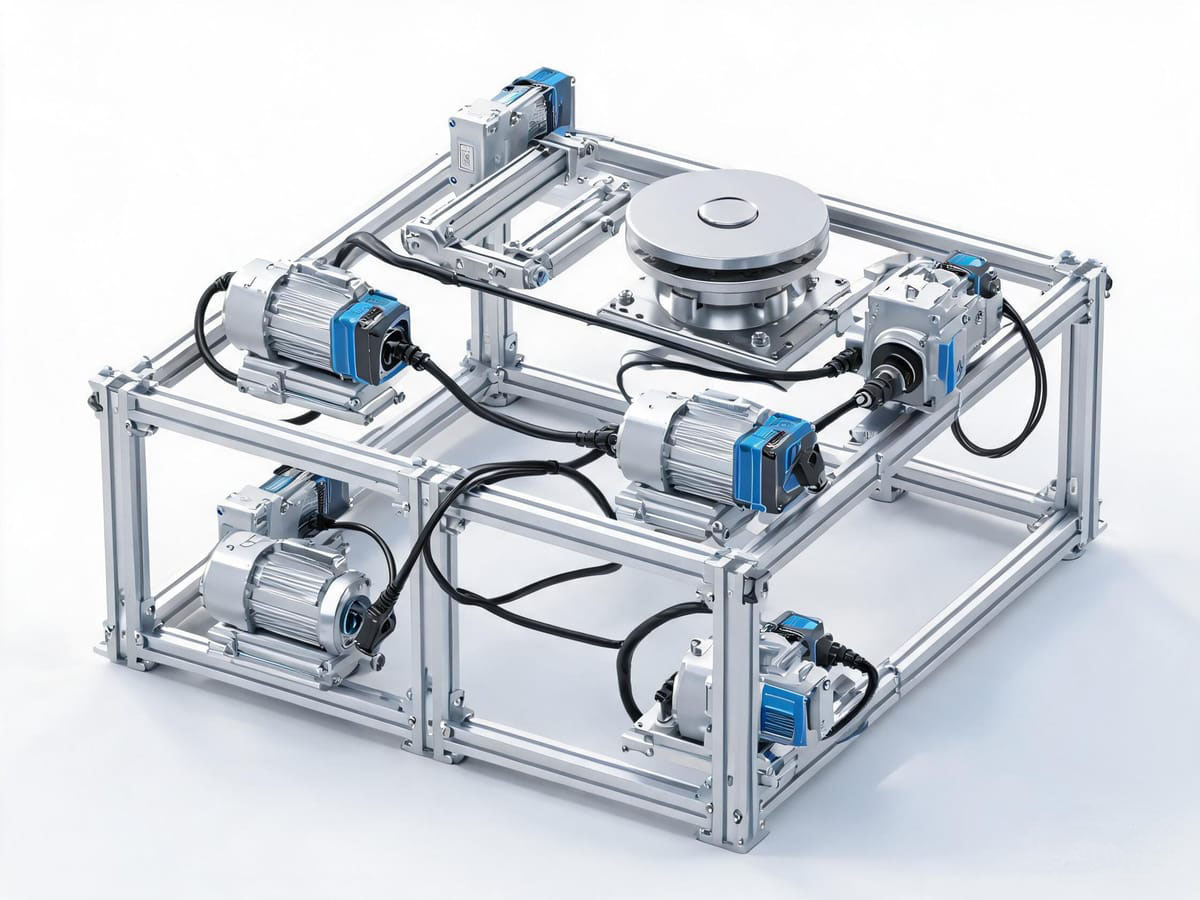
Figure: Integrated (drive-in-one) motor — in multi-axis equipment it saves the driver, encoder cable, and cabinet space, and networks over the bus