
Motor IP Rating Explained: How to Choose IP54 / IP65 / IP67 / IP69K
The single most important insight: IP65 and IP67 are not "the latter is better" — they are "different test conditions." An IP67 motor can be submerged in 1 meter of water for 30 minutes, but hosing it down with a water jet may let water in; an IP65 motor can withstand water sprayed from all directions, but soaking it in water for half an hour may damage it. The two are complementary, but they cannot replace each other.
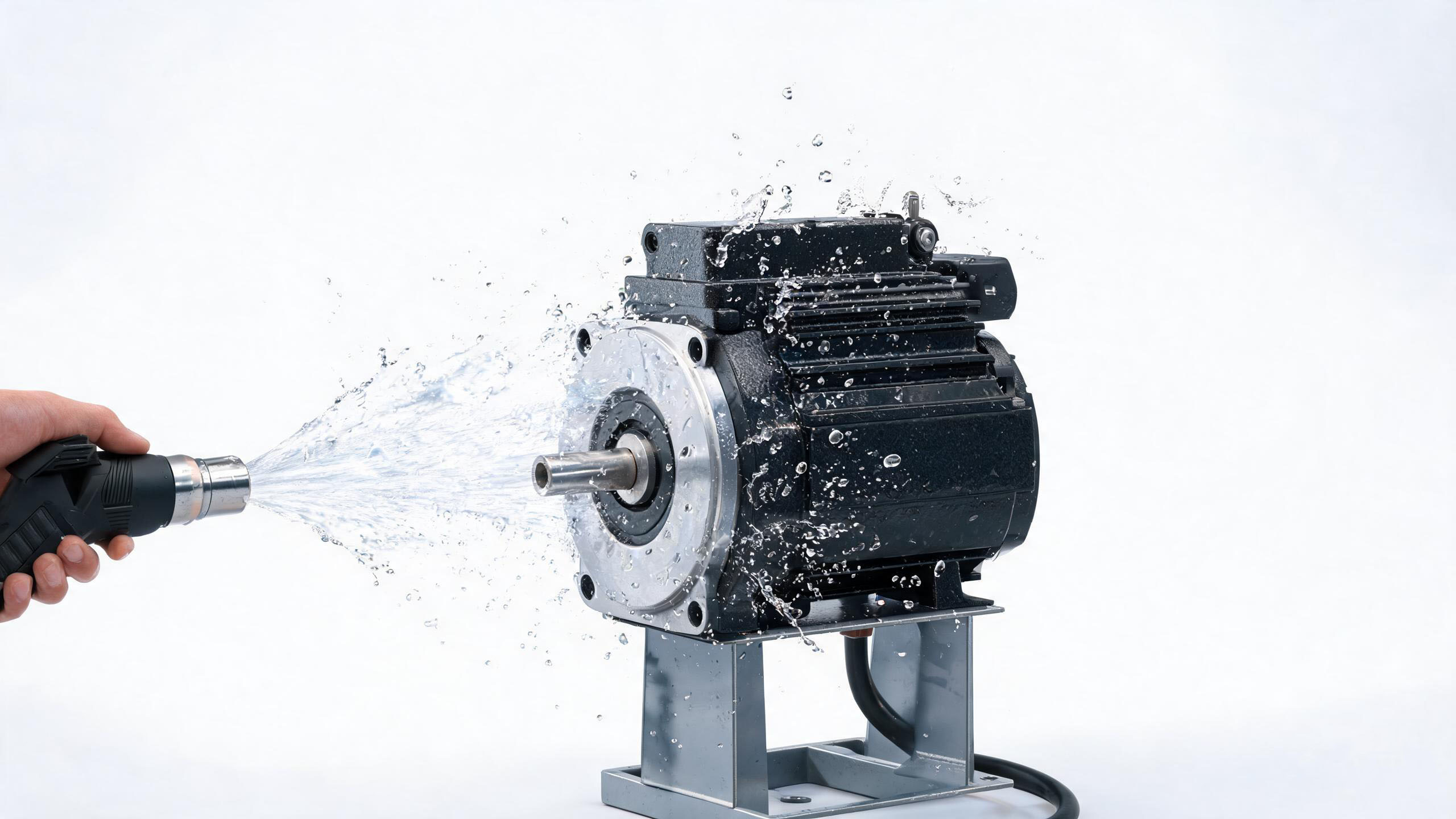
Figure: An IP rating measures a motor's ability to resist ingress of solid particles and liquids — a water spray test is just one of the scenarios
1. What Is the IP Code
IP = Ingress Protection, also often interpreted as International Protection.
It is defined by the International Electrotechnical Commission (IEC) in standard IEC 60529, published in the EU by CENELEC as EN 60529, and in the UK as BS EN 60529.
What it solves: replacing vague marketing terms like "waterproof" and "dustproof" with standardized, verifiable ratings.
Code Structure
IP 6 5 K
│  │ │ └── Supplementary letter (optional): H high-voltage equipment / M moving during water test / S stationary during water test / W weather conditions
│  │ └──── Second digit: liquid protection (0–9, or X)
│  └────── First digit: solid particle protection (0–6, or X)
└───────── Code lettersNote:
The standard IP code has no hyphen; writing "IPX-8" is incorrect;
A digit of X means that dimension is untested or has no data;
Ratings do not require "passing level by level" — an IP67 device has not been spray-tested, only immersion-tested.
2. First Digit: Solid Particle Protection (0–6)
Digit | Protected Against | Description |
|---|---|---|
0 | — | No protection |
1 | > 50 mm | Large objects such as the back of a hand; does not prevent deliberate contact |
2 | > 12.5 mm | Fingers or similar objects |
3 | > 2.5 mm | Tools, thick wires |
4 | > 1.0 mm | Thin wires, small screws, large ants |
5 | Dust-protected | Dust ingress not sufficient to affect safe normal operation (not fully prevented) |
6 | Dust-tight | No dust ingress at all, vacuum test required, up to 8 hours |
Practical criteria:
IP2X is the minimum requirement for touchable equipment (fingers must not reach live parts);
IP4X suits general indoor use;
IP5X / IP6X are critical for outdoor, dusty, sandy, and soil environments.
3. Second Digit: Liquid Protection (0–9)
Digit | Protection Against | Test Conditions |
|---|---|---|
0 | No protection | — |
1 | Vertically dripping water | Water drops falling vertically |
2 | Dripping water at 15° tilt | Vertical dripping while the enclosure is tilted to 15° |
3 | Spraying water | Water sprayed within 60° of the vertical |
4 | Splashing water | Water splashed from any direction, limited ingress allowed |
5 | Water jets | Low-pressure water jets from any direction (6.3 mm nozzle, 12.5 L/min), limited ingress allowed |
6 | Powerful water jets | Powerful water jets (12.5 mm nozzle, 100 L/min), limited ingress allowed |
7 | Temporary immersion | Immersed in 1 meter of water for 30 minutes |
8 | Continuous immersion | Continuously immersed beyond 1 meter, depth and time specified by the manufacturer |
9 / 9K | High-pressure, high-temperature jets | Close-range high-pressure, high-temperature water jets (industrial cleaning) |
Key transition points:
From 4 to 5: upgrading from "splash-proof" to "jet-proof," a qualitative change;
From 6 to 7: jumping from "jet-proof" to "submersible," an even bigger leap.
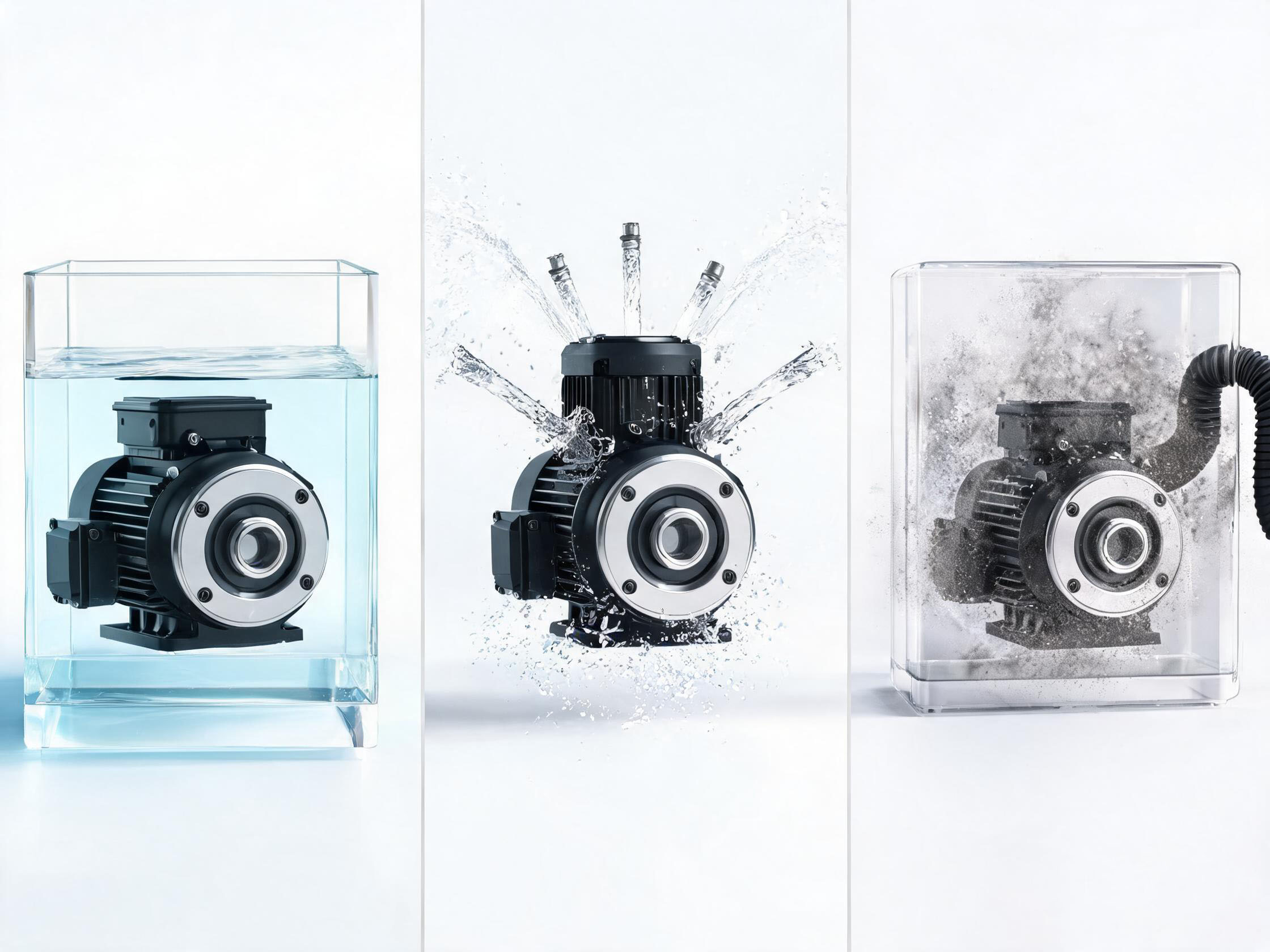
Figure: IP ratings are defined by standardized tests — immersion, water jet, and dust tests each have different conditions
4. Detailed Explanation and Selection of Common Ratings
IP20
No dust or water protection (only against solids larger than 12.5 mm). A standard configuration for dry indoor environments. Never use it in kitchens, bathrooms, outdoors, or any place with water.
IP44
Solids: protects against objects > 1 mm
Liquids: protects against splashing water from any direction
Suitable for indoor environments with a risk of splashing.
IP54
Solids: dust-protected (level 5, limited ingress allowed but does not affect operation)
Liquids: splash-proof (level 4)
Suitable for general industrial workshops — dusty but not severe, with occasional water splashes. It is a common basic configuration for industrial motors.
IP65 (Standard for Industrial Outdoor Use)
Solids: dust-tight (level 6, no dust ingress at all)
Liquids: protects against low-pressure water jets from any direction (6.3 mm nozzle, 12.5 L/min, limited ingress allowed)
Typical applications: outdoor lighting and equipment, industrial equipment that may be rained on or hosed down, food processing workshops, dusty industrial environments.
This is the most commonly used outdoor rating for industrial motors. Limaisheng NiMotion's PMM integrated servo motors and STM86 integrated stepper motors both reach IP65.
IP67
Solids: dust-tight
Liquids: immersed in 1 meter of water for 30 minutes
Typical applications: places that may be temporarily submerged — outdoor floor sockets, underground cable joints, equipment that may be flooded, marine environments.
Important reminder: IP67 does not mean it can withstand water jet washing. It has only been tested for static water immersion.
IP68
Solids: dust-tight
Liquids: continuous immersion, depth and time specified by the manufacturer
Typical applications: long-term underwater equipment — pond lights, pool lighting, underwater sensors.
Note: the specific conditions of IP68 (how deep, how long) must be clearly stated by the manufacturer; otherwise the rating has no meaning.
IP69K
Protects against close-range high-pressure, high-temperature water jets.
Typical applications: places requiring high-pressure hot water washing — food and beverage processing (CIP cleaning), pharmaceuticals, chemicals. This is the highest requirement in the food and pharmaceutical industries.
IP6K4 (A Special Rating)
Appears in ISO 20653 (road vehicle protection rating — note, not IEC 60529), meaning:
First digit 6: dust-tight
Second digit K4: protects against splashing from high-pressure/steam jet cleaning (vehicle-standard specific)
Limaisheng NiMotion's STM57 integrated stepper motor is rated IP6K4, and with its -40 to +85°C wide-temperature operating range, it suits vehicles and demanding industrial environments.
5. "Bigger Numbers Are Better" Is a Misconception
Three Clarifications
① IP67 is not necessarily better than IP65
An IP67 device has not been spray-tested, only static water immersion-tested. Rinsing it under a faucet may actually let water in. Conversely, an IP65 device can withstand water jets, but soaking it in water for half an hour may damage it.
② Ratings do not require passing level by level
The standard does not require an IP67 device to pass IPX5 or IPX6 tests. A device rated IP67 may completely fail an IPX5 spray test.
③ If both conditions must be met, dual rating is needed
If a device may be both washed and immersed, it needs to simultaneously satisfy IP65 and IP67 (some products are marked "IP65 / IP67").
Selection Decision Table
Operating Environment | Recommended Rating |
|---|---|
Dry indoor, inside a control cabinet | IP20 / IP44 |
General industrial workshop (dusty, occasional splashes) | IP54 |
Outdoor, rain, may be washed down | IP65 |
Workshop with severe dust | IP65 (first digit must be 6) |
May be flooded, floor water accumulation | IP67 |
Long-term underwater | IP68 (confirm depth and time) |
Food/pharmaceutical, high-pressure hot water cleaning | IP69K |
Road vehicles, steam cleaning | IP6K series (ISO 20653) |
6. Waterproof Motor Selection: What Else to Consider Besides the IP Rating
① Sealing of the Cable Exit (the Weakest Point)
Making a motor housing IP65 is not hard; the hard part is the cable exit. Pay attention to:
Whether a waterproof aviation connector is used (e.g., M12, M8 industrial connectors);
Or a direct cable exit (the cable sheath rating and how it is secured);
Whether the cable entry has a waterproof cable gland (PG gland / cord grip) and is properly tightened.
Field experience: in many "IP65 motor water ingress" cases, the problem is at the cable exit, not the housing.
② Shaft Seal (Dynamic Sealing of the Rotating Shaft)
The shaft is the only "moving" part and the hardest to seal. Pay attention to:
Whether an oil seal / skeleton oil seal is used;
The compatibility of the shaft seal material with the media (water, oil, chemical cleaning agents);
The wear life of the shaft seal at high rotation speeds.
③ The "Breathing Effect" Caused by Temperature Cycling
When a motor heats up during operation and cools down when stopped, the air inside the cavity expands and contracts, "breathing" through seal gaps and possibly drawing moisture into the cavity.
Countermeasures:
Use a breather valve / waterproof breathable membrane (Gore-Tex type) to balance internal and external pressure while blocking liquid water;
Avoid frequent severe temperature cycling.
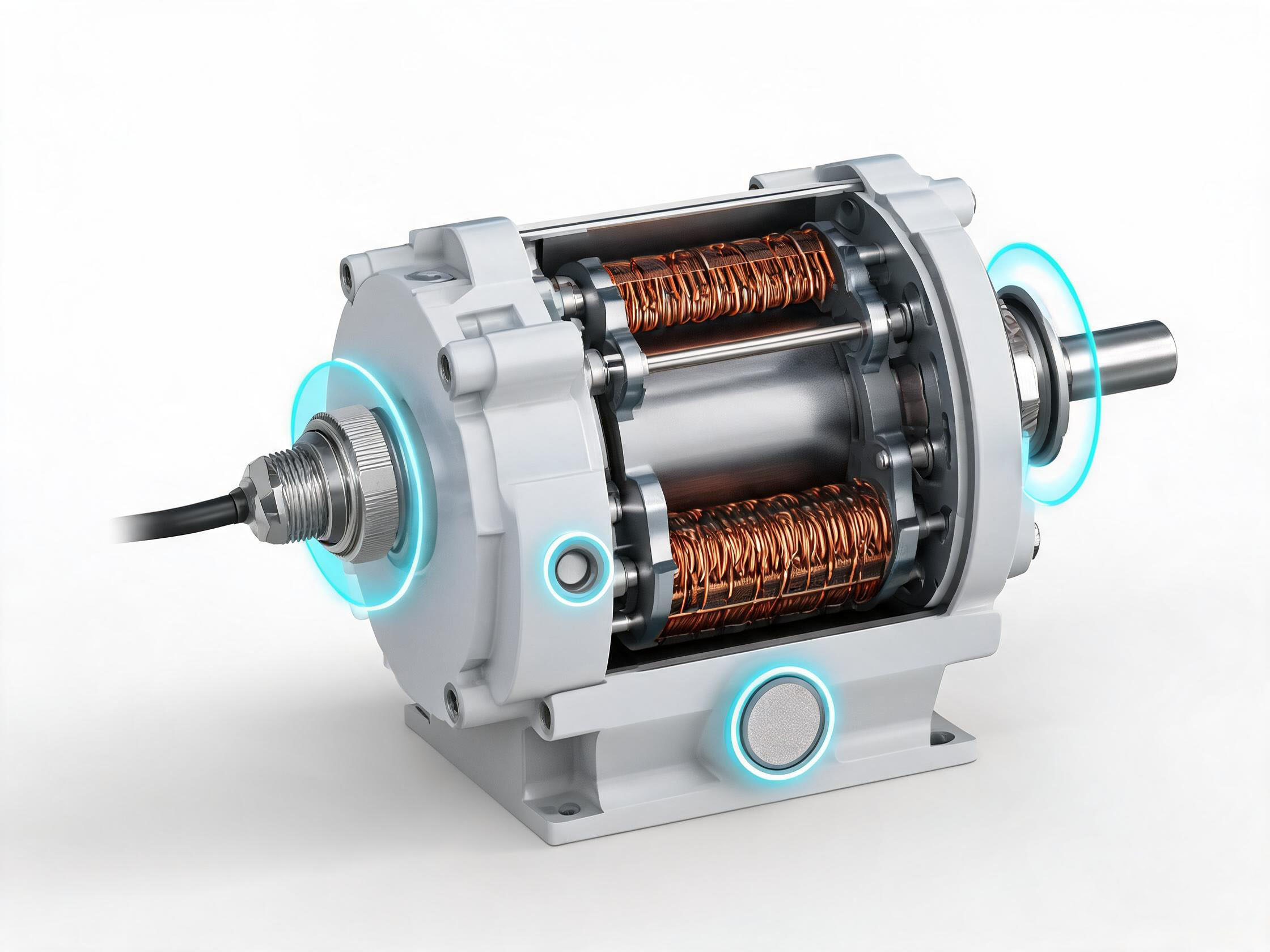
Figure: The three key sealing points of a waterproof motor — waterproof cable gland at the cable exit, shaft seal, and waterproof breathable membrane
④ Protection Rating ≠ Corrosion Resistance
An IP rating only covers ingress of solids and liquids, not corrosion.
Seaside salt-spray environments → require additional anti-corrosion coating or stainless steel material;
Chemical environments → need to confirm material compatibility and seal material (FKM vs NBR).
⑤ Seal Aging
Protection rating tests are performed on new-condition products. Rubber seals age over time, so:
Regularly inspect seal condition;
Replace seals at the manufacturer's recommended intervals;
Avoid prolonged over-temperature operation (accelerates seal aging).
7. Recommendations for Combining with Motor Selection
By Application Scenario
Scenario | Recommended Protection Rating | Other Notes |
|---|---|---|
Indoor automation equipment | IP54 | Basic dust and splash protection |
Food packaging, filling | IP65, IP69K in wash-down areas | Needs cleaning-agent resistance, stainless steel or food-grade coating |
Medical analytical instruments | IP54 / IP65 | Heat inside a sealed enclosure is the main issue; prefer low-heat closed-loop solutions |
AGV / inspection robots | IP65 and above | Outdoor rain and dust protection |
Outdoor PV, wind power | IP65 + wide temperature | Needs -40°C operating temperature and UV resistance |
Ships, docks | IP66 / IP67 + anti-corrosion | Salt-spray corrosion is the main threat |
Mines, cement | IP65 / IP66 (first digit must be 6) | Very fine dust, must be dust-tight |
Semiconductors, cleanrooms | Depends on cleanliness class, plus low particle emission | Not fully related to IP rating |

Figure: Food and beverage, outdoor, and demanding industrial scenarios require higher protection ratings — IP65/IP69K are common choices
The Protection Advantage of Integrated Motors
Integrated (drive-in-one) motors have a natural advantage in protection design: fewer external interfaces that need sealing.
A traditional split servo needs: power cable interface + encoder cable interface + I/O interface (each a potential water entry point).
An integrated motor needs only: power interface + communication interface (two).
Limaisheng NiMotion's protection design:
PMM / PSM integrated servo: IP65
STM86 integrated stepper: IP65, operating temperature -40 to +75°C
STM57 integrated stepper: IP6K4, operating temperature -40 to +85°C