
Torque Motor vs Servo Motor: Principle, Advantages and Selection Boundaries of Direct-Drive Torque Motors
One sentence to clarify the fundamental difference: "Servo" emphasizes control — being able to precisely control position, speed, and torque; "torque" emphasizes capability — being able to continuously output large torque at low speed or even zero speed. The two are not mutually exclusive alternatives. A modern frameless torque motor equipped with a high-precision encoder is itself a servo motor.
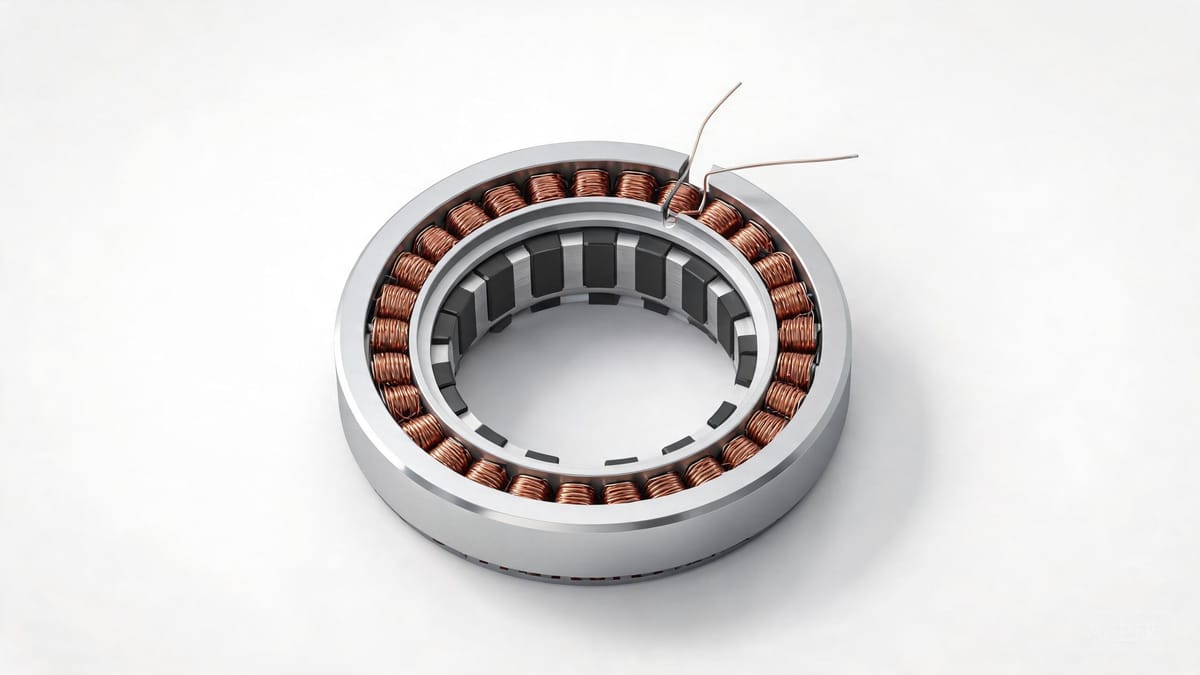
Figure: Frameless direct-drive torque motor — multi-pole stator and rotor ring, built for low-speed high torque
1. First Clarify: These Are Concepts from Two Different Dimensions
This is the first step to understanding the two, and the point many materials fail to explain clearly.
Concept | Emphasized Dimension | Question It Answers |
|---|---|---|
Servo motor | Control method | Can it precisely control position/speed/torque? |
Torque motor | Output characteristics | Can it continuously output large torque at low speed (even stall)? |
Therefore:
A torque motor ≠ cannot do servo control. Quite the opposite — a modern frameless torque motor with a high-precision encoder has excellent servo performance;
A servo motor ≠ cannot output torque. It just has a different design goal.
The name "torque motor" expresses its core design philosophy: born for torque.
2. Why Can a Torque Motor Output Such Large Torque at Low Speed
An intuitive comparison:
A typical 400W servo motor has a rated torque of about 1.3 N·m and a stall torque of about 3 N·m;
A frameless torque motor of the same outer diameter can achieve a dozen or even dozens of N·m of continuous stall torque.
The difference comes from three aspects:
Reason 1: Very Large Number of Pole Pairs
Motor Type | Typical Number of Pole Pairs |
|---|---|
Ordinary servo motor | 3-pole, 4-pole, up to 8-pole |
Frameless torque motor | 14-pole, 20-pole, 30-pole, or even more |
The more pole pairs, the greater the torque produced at the same current. It is like the difference between turbocharged and naturally aspirated — at the same displacement, the turbocharged engine produces more power.
Additional benefit: with more pole pairs, the cogging effect of each magnetic pole is averaged out, torque ripple is smaller, and low-speed smoothness is significantly improved.
Reason 2: Higher Air-Gap Flux Density
Frameless torque motors usually use high-performance NdFeB magnets, and the magnets are relatively thicker (longer magnetization direction), increasing the air-gap flux density and thereby the torque density.
Ordinary servo motors, to control cost, often use magnets with lower energy product or make the magnets very thin.
Reason 3: Shorter Heat-Dissipation Path
Ordinary servo motor: sealed in an iron housing, heat can only dissipate by natural convection through the housing surface;
Frameless torque motor: mounted directly on the equipment's structural parts; the stator back iron couples to the metal housing through thermally conductive adhesive, short heat-dissipation path, high efficiency.
Better heat dissipation → can carry more current → can output more torque. It is like the difference between air-cooled and water-cooled engines.
3. Structure: What Are "Frameless" and "Direct Drive"
Frameless
Torque motors are usually frameless motors — without a housing, bearings, or a measurement system. These parts are selected by the machine manufacturer according to performance requirements, or purchased as a set.
This brings two results:
Advantage: can be deeply integrated into the mechanical body, with small system size and low inertia;
Cost: high requirements on mechanical design and assembly precision, raising the user's engineering capability threshold.
Direct Drive
Torque motors are direct-drive motors — the load connects directly to the rotor, requiring no transmission components.
But note that "direct drive" has two completely different technical routes in the industry:
Route | Description | Features |
|---|---|---|
Coupling direct drive | Ordinary servo motor + hollow sleeve structure, coupling the motor shaft to the driven shaft | No gearbox, but still has a coupling and bearings, with some flexibility |
True direct drive | The frameless motor rotor mounts directly on the equipment's rotating part; the stator is fixed to the stationary structure | The motor itself is part of the rotary joint, with zero backlash |
A common misconception: thinking that "as long as there is no gearbox between the motor and the driven part, it is direct drive." Strictly speaking, only the latter counts.
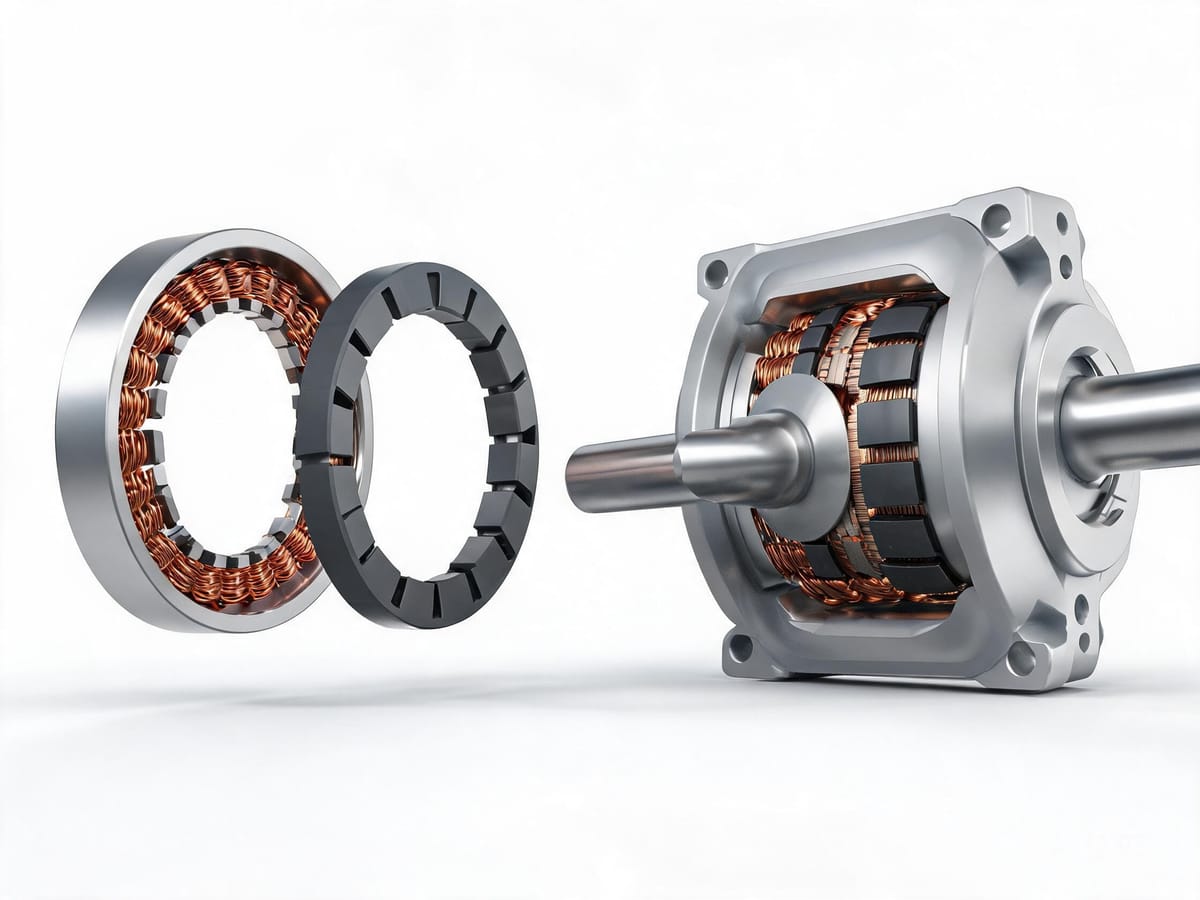
Figure: Frameless torque motor — stator and rotor ring are separate and integrated directly into the equipment's rotating part, with zero backlash
A common misconception: thinking that "as long as there is no gearbox between the motor and the driven part, it is direct drive." Strictly speaking, only the latter counts.
A Vivid Analogy
A torque motor can be seen as:
A linear motor rolled into a circle;
Or a traditional servo motor with a very large number of pole pairs.
4. Core Difference Comparison Table
Dimension | Torque Motor (Frameless Direct Drive) | Traditional Servo Motor |
|---|---|---|
Design goal | Low-speed/zero-speed high torque | Wide speed range + high dynamics |
Torque density | High | Medium |
Rotor inertia | Low (frameless, no additional rotating parts) | Medium (includes its own rotor inertia) |
Transmission method | Direct drive, no transmission parts | Usually needs coupling + gearbox |
Backlash | Zero (no transmission chain) | Present (gearbox backlash; high-precision type < 3 arc-min) |
Settling time | Short (good stiffness, no flexible links) | Longer (affected by coupling/belt flexibility) |
Accuracy | Extremely high (no transmission error accumulation) | High (affected by transmission error) |
Speed range | Low–medium speed | Wide (can exceed 3000 rpm) |
Structural form | Frameless bare motor, user integration required | Complete finished product, plug-and-play |
Mechanical design threshold | High (must design bearings, housing, encoder mounting) | Low |
Tuning difficulty | Medium–high | Medium (most auto-tune) |
Cost (single unit) | Medium–high | Medium |
System cost | Can be lower (saves gearbox, coupling, flange) | Must add transmission component costs |
Typical applications | Robot joints, rotary tables, medical exoskeletons, semiconductor indexing | Machine tool feed, automation lines, high-speed pick & place |
5. When to Choose a Torque Motor and When to Choose Servo + Gearbox
✅ Situations for Choosing a Torque Motor (Direct Drive)
Condition | Reason |
|---|---|
Zero backlash required | No transmission chain, fundamentally eliminates return clearance |
Low-speed high torque, stall allowed | The core capability of a torque motor |
Extremely high positioning and repeatability required | No transmission error accumulation, no flexible deformation |
Low noise, maintenance-free required | No gearbox, no lubrication needs |
Flat space (large diameter, short axial) | Torque motors are naturally flat in configuration |
Hollow shaft routing needed | Large hollow shafts allow cables and air hoses to pass through |
Typical equipment: robot joints, direct-drive rotary tables (DDR), semiconductor index tables, medical exoskeletons, optoelectronic gimbals, precision rotary tables, radar antennas.
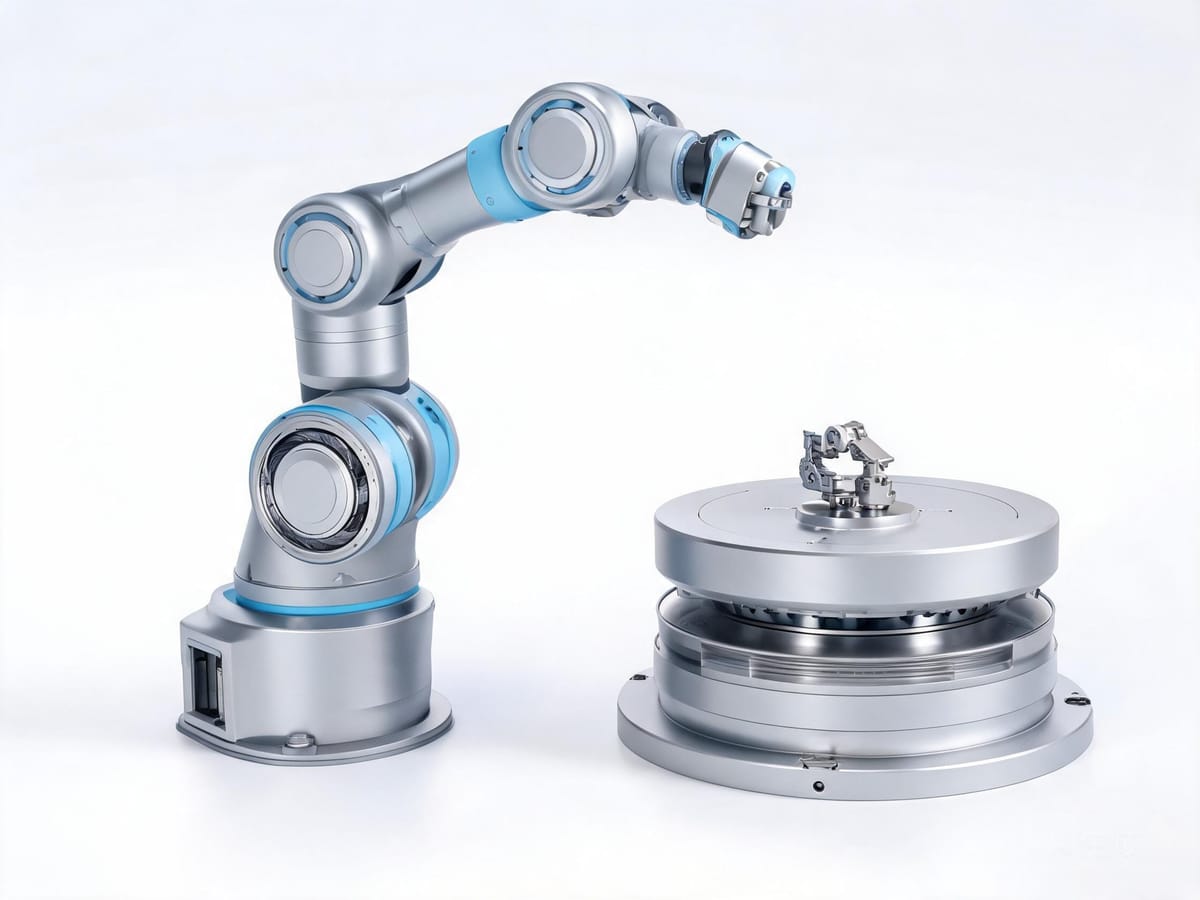
Figure: Direct-drive torque motor applications — robot joints, direct-drive rotary tables (DDR) and other zero-backlash, high-precision positioning scenarios
✅ Situations for Choosing Servo + Planetary Gearbox
Condition | Reason |
|---|---|
High speed needed (> 1000 rpm) | Torque motor speed range is limited |
Large load inertia ratio | The gearbox decays load inertia by i², the most economical inertia-matching method |
Cost-sensitive | In small-to-medium power applications, servo + gearbox total cost is usually lower |
Limited mechanical design capability | A servo is a finished product, plug-and-play; a frameless motor requires strong integration capability |
Standardization and easy maintenance needed | Servo + gearbox are replaceable standard parts |
Existing mature solution | Following a mature design significantly reduces risk |
Typical equipment: CNC feed axes, packaging machinery, logistics sorting, AGV drive wheels, electric cylinders.
A Decision Table
Your Need | Recommendation |
|---|---|
Speed > 1500 rpm | Servo + gearbox |
Backlash = 0 required | Direct-drive torque motor |
Inertia ratio > 10:1 | Servo + gearbox (solve inertia matching first) |
Hollow shaft routing needed | Direct-drive torque motor |
Limited budget, many axes | Servo + gearbox |
Flat space, radially constrained | Direct-drive torque motor |
Sustained stall torque output needed | Torque motor |
Standardization, fast delivery priority | Servo + gearbox |
6. Cost Comparison: Don't Compare Only the Unit Price
A common misjudgment is "torque motors are expensive." The correct comparison should look at system cost:
Cost Item | Direct-Drive Torque Motor | Servo + Planetary Gearbox |
|---|---|---|
Motor body | Medium–high | Medium |
Gearbox | None | Must be purchased (high-precision types are not cheap) |
Coupling | None | Must be purchased |
Flange/mounting base | Must be designed | Must be purchased |
Bearings | Must be integrated by the user | Included in the gearbox |
Encoder | Must be selected separately | Built into the motor |
Mechanical design labor | High (frameless requires self-integration) | Low |
Assembly precision requirement | High | Medium |
Maintenance cost | Low (no lubrication, no wearing parts) | Needs periodic grease replacement |
Accuracy retention | Good (no wear, accuracy does not decay) | Decays as backlash increases |
Conclusion:
Medium-low precision, cost-sensitive, many axes → servo + gearbox has better total cost;
High precision, maintenance-free, long-life requirements → direct drive often has lower total cost of ownership (TCO), because it eliminates the gearbox's maintenance, replacement, and accuracy-decay costs.
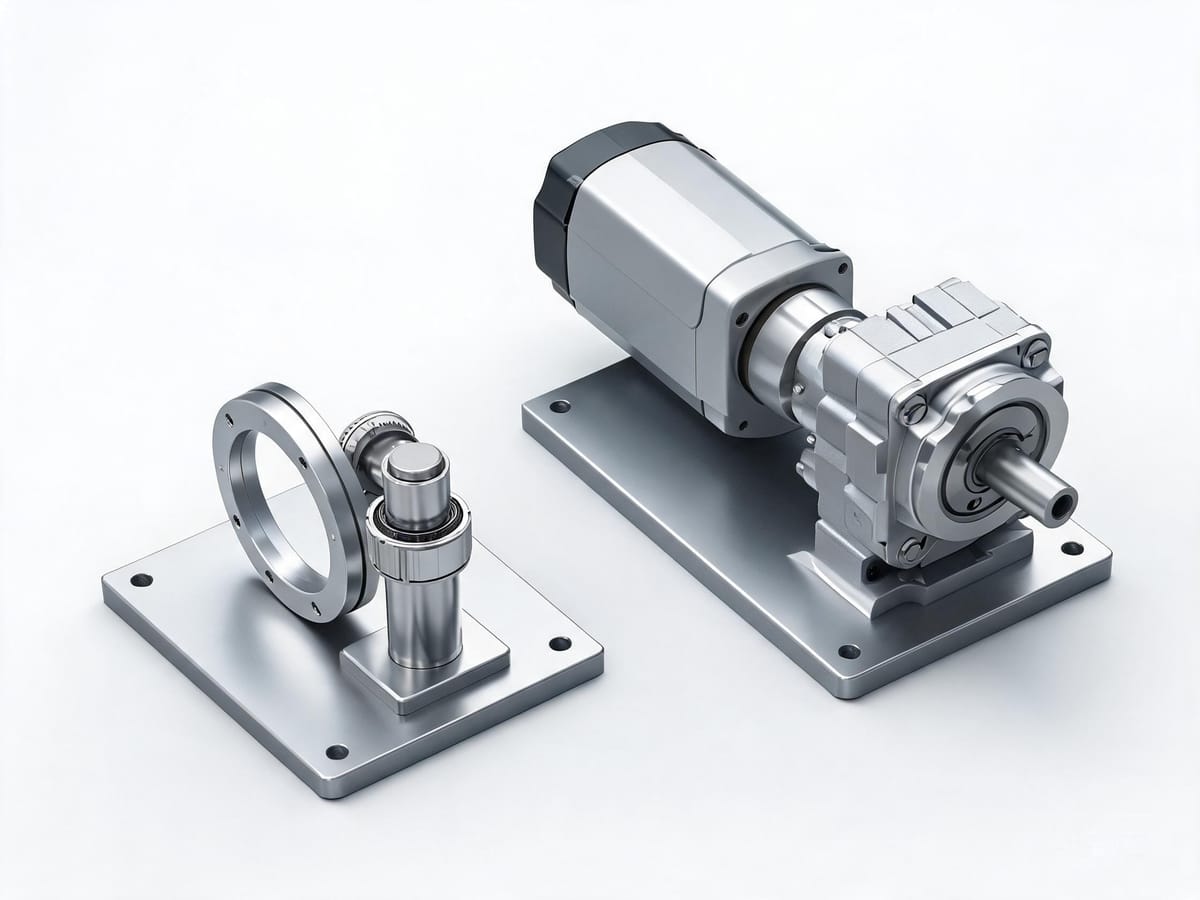
Figure: Direct-drive torque motor (left) vs servo + planetary gearbox (right) — differences in transmission chain and system cost
7. Three Key Points for Torque Motor Selection
1. Size by Torque, Not by Power
This is the biggest difference between a torque motor and a traditional motor:
The specification and selection of a torque motor depend mainly on torque, not power.
Two values must be distinguished:
Parameter | Meaning | Role |
|---|---|---|
Peak Torque | The maximum torque the motor can actually produce | Determines acceleration capability and overload margin |
Continuous Torque | The torque the motor can provide continuously | Determines thermal balance and long-term working capability |
The application's duty cycle determines whether peak torque or continuous torque is the dominant factor:
Short-time large load, intermittent work → look at peak torque;
Continuous stall (e.g., winding tension control) → look at continuous torque, and must verify heat dissipation.
2. Must Verify Heat-Dissipation Conditions
Continuous torque depends directly on heat dissipation. A torque motor dissipates heat through the equipment's structural parts, so:
The material, area, and heat-dissipation conditions of the mounting surface must be clarified;
High-temperature environments or enclosed spaces require derating;
If necessary, add forced air cooling or water cooling.
3. The Encoder Determines the Final Accuracy
A frameless motor itself contains no feedback device; the encoder is selected by the user. The encoder's resolution directly determines the upper limit of system accuracy:
General automation: 17-bit (131072 positions/rev);
High-precision rotary tables/robot joints: 20–23 bit;
Power-off position retention needed: choose multi-turn absolute.
8. Limaisheng NiMotion's Corresponding Solutions
For applications that do not need frameless integration but want a direct-drive-like compact experience, Limaisheng NiMotion's integrated motors provide a compromise path:
Need | NiMotion Solution |
|---|---|
Compact space, maintenance-free required | Integrated (drive-in-one) motor: driver + encoder + communication integrated into the motor body, leaving only a power cable and a bus cable |
Large torque, medium-low speed needed | Integrated servo + planetary gearbox: PMM/PSM series + gearbox, balancing torque and inertia matching |
Low-voltage, mobile equipment | Low-voltage integrated servo (DC 24/48V): suitable for AGVs, collaborative robots, portable equipment |
Medium-low speed, no lost steps, low heat | Integrated closed-loop stepper (STM series): built-in 14-bit absolute encoder |
Hollow routing / flat mounting | Custom flanges and cable exits can be made per the operating conditions |
Core difference: an integrated motor is still a framed finished product (with bearings, housing, encoder), plug-and-play, with a mechanical integration threshold far lower than a frameless torque motor; at the same time it is superior to the traditional "servo + driver" separate solution in integration, wiring, and diagnosability.