
What Is a Closed-Loop Stepper Motor? Open-Loop vs. Closed-Loop (2026)
A closed-loop stepper motor adds an encoder to a stepper motor, so the driver continuously compares commanded position with actual position and corrects the difference. It keeps the stepper's low cost and high holding torque while removing the step-loss problem. The real difference from an open-loop stepper is not the encoder as a part — it is whether an error can be detected and corrected at all.
1. Start with open loop
An open-loop stepper moves on pulses. Each pulse from the controller turns the motor by a fixed step angle, and the controller derives position by counting pulses — it has no idea where the motor actually is.
This is simple and cheap, and it works well with stable loads at moderate speed. The catch is the absence of feedback: if the motor falls behind because of excessive load, aggressive acceleration or too high a speed, the controller still believes position is correct and the error accumulates. That is step loss.
2. What closed loop adds
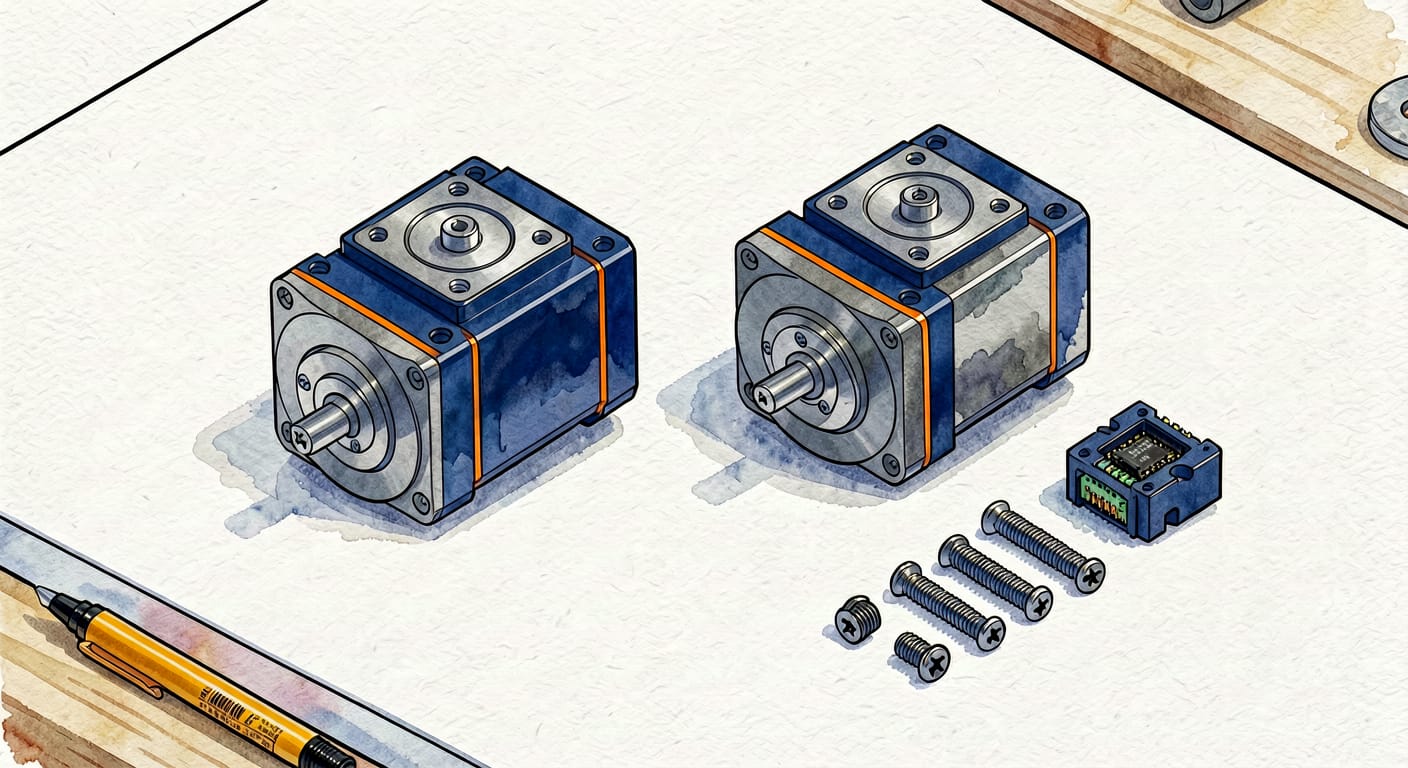
A closed-loop stepper fits an encoder at the rear of the motor and feeds actual position back to the driver, which continuously compares it with the commanded position:
When a deviation appears, current and output are adjusted to pull position back
Under a sudden load change or excessive speed, the drive raises an alarm or derates instead of silently losing steps
You no longer need to oversize the motor to keep a step-loss margin, so the selected frame can sit closer to the real requirement
Limaisheng (NiMotion) builds this class of product as an integrated stepper servo (STM-M series), described by the company as combining the low cost of a stepper with the high response of a servo. In the model code the operating-mode field carries an A for closed-loop control — in STM 57 56 A - 485 - H - 0 F S B, the A means closed loop; omitting it means open loop.
Table: Open-loop vs. closed-loop stepper — core differences
Item | Open-loop stepper | Closed-loop stepper (stepper servo) |
|---|---|---|
Position feedback | None; derived from pulse counting | Encoder feeds back actual position |
Step loss | Undetected; error accumulates | Corrected in real time, or alarm / derate |
Low-speed smoothness | Prone to vibration and noise | Smoother under closed-loop regulation |
High-speed torque | Falls off noticeably with speed | Falls off more gradually; wider usable range |
Sizing margin | Usually needs a large margin | Margin can be much smaller |
Cost | Low | Higher than open loop, lower than an equivalent servo |
3. How closed-loop steppers relate to servos
The three are often lumped together, but they sit in different places. Steppers offer high torque at low speed, low cost and simple control. Servos offer fast response, strong high-speed performance and high accuracy, at a higher price and with more tuning. A closed-loop stepper sits in between — the company describes it as combining the low cost of a stepper with the high response of a servo — for applications that want to avoid step loss without paying for a servo.
Table: Stepper vs. closed-loop stepper vs. servo positioning
Dimension | Open-loop stepper | Closed-loop stepper | Servo |
|---|---|---|---|
Cost | Low | Medium | High |
Low-speed torque | Good | Good | Moderate |
High-speed performance | Weak | Moderate | Strong |
Commissioning | Barely needed | Light | Extensive parameter tuning |
Typical use | Stable load, moderate speed | Step-loss risk, limited budget | High dynamics and accuracy |
4. When to go closed loop
The load varies, or overload and stall are possible
Positioning accuracy matters and silent step loss is unacceptable
Smooth low-speed motion with low vibration and noise is required
Downtime is expensive and faults must be reported promptly
The motor was oversized purely to guard against step loss and you want that margin back
5. When open loop is enough
Stable load, moderate speed, virtually no overload risk
Loose accuracy requirements with occasional deviation tolerable
Highly cost-sensitive, and the open-loop design is already proven reliable