
Where the Money Goes in a Humanoid Robot: Frameless Torque Motors Down 75%, Reducers from RMB 1,280 to RMB 410
Bottom line: Actuators — motor, reducer and screw — consume more than 50% of a humanoid robot's hardware cost, and core components together exceed 60%. Over the past three years, this largest cost block traced a steep decline: frameless torque motors fell from RMB 2,000 to around RMB 500, and same-spec reducers from RMB 1,280 to RMB 410. But falling prices are not free — the selection logic has to change with them.
What exactly makes a humanoid robot expensive? Open up the BOM and the answer is more concentrated than most people expect.
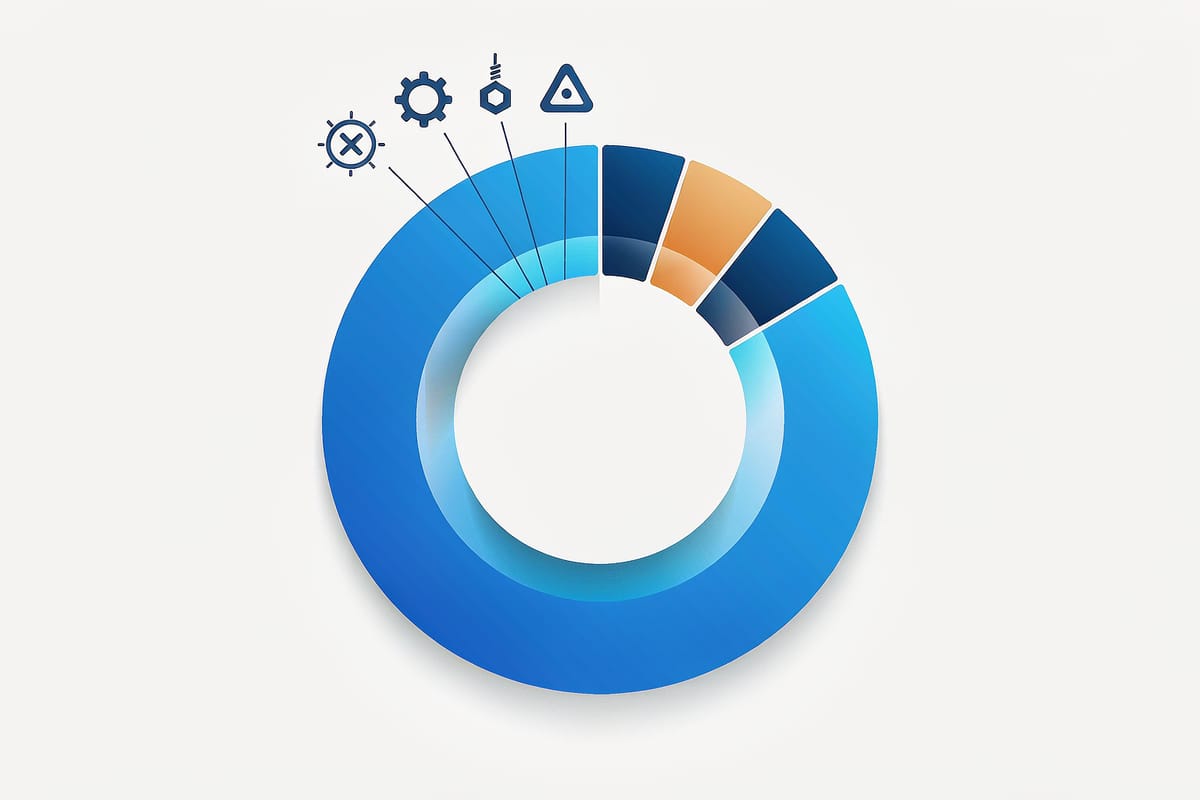
Cost Structure: More Than 60% Goes to Making the Joints Move
Cost item | Share / amount | Note |
|---|---|---|
Actuators (motor + reducer + screw) | Over 50% of total hardware cost | The robot's joints |
Dexterous hands | 20–25% of hardware cost | Each hand needs several micro motors |
Core components combined | Over 60% | Including sensors and encoders |
Frameless torque motor | One per actuator across 28 units; ~RMB 1,200 each → about RMB 33,600 per robot, or 10.63% of BOM | Main rotary joint solution |
Hollow cup motor | About RMB 9,600 per robot, equal to 38% of Tesla's dexterous hand cost | Largest single cost in the hand |
Sources: public industry estimates, Tonghuashun, 2026-09.
One comparison is easy to miss: a six-axis industrial robot uses only six servo axes, while Tesla's Optimus has 28 body joints and more than 50 degrees of freedom including the hands. That order-of-magnitude difference in joint count is the root cause of the dramatic shift in servo volume and cost structure.
Three Core Components: Localization and Price Curves
1. Reducers: localization nearly quadrupled in three years
Indicator | 2023 | 2026 |
|---|---|---|
Localization rate | 18.7% | Above 72% |
Same-spec purchase price | RMB 1,280 | RMB 410 |
In harmonic reducers, Leaderdrive holds over 60% of China's humanoid-specific segment, exclusively supplying the 12 hand joints of XPeng IRON and offering the industry's smallest 16 mm harmonic joint. On capacity, its monthly output rose from about 50,000 units in Q1 to roughly 70,000, targeting 100,000–120,000 by year end; Laifual's expanded capacity is expected to reach 800,000 units annually.
One caveat: RV reducer localization remains below 25%, making it the next major battlefield in the reducer segment. Do not assume harmonics can substitute in heavy-load applications.
2. Frameless torque motors: from RMB 2,000 to around RMB 500
Indicator | 2023 | 2026 |
|---|---|---|
Localization rate | 23.1% | 69.5% |
Unit price | RMB 2,000 | Around RMB 500 |
Overseas, Maxon of Switzerland and TQ-RoboDrive of Germany long dominated. Among domestic players, Inovance has entered the supply chains of Tesla, Unitree and Xiaomi; Leadshine delivered over 120,000 units in 2025, reportedly supplying 80% of mainstream Chinese humanoid makers, and is building automated capacity of 2 million units per year; Xinje plans around 2 million units this year and 3 million next.
The caution here: do not look only at price — look at torque density. Overseas leaders retain barriers in high-end custom windings and thermal management. Between two "frameless torque motors" with a 30% torque density gap, machine weight and battery life come out completely different.
3. Hollow cup motors: the largest cost item in the hand
A dexterous hand needs several hollow cup motors of 8–10 mm diameter at roughly RMB 800 each, coming to about RMB 9,600 per robot and 38% of the cost of Tesla's hand.
The price comparison is direct: Moons' 8 mm hollow cup motor lists at about RMB 996, while Maxon's equivalent is about RMB 2,198. Zhaowei Machinery has built a complete module combining self-developed hollow cup motor, reducer and screw, and invested RMB 800 million in a dedicated dexterous hand industrial park in Bao'an, Shenzhen.

How the 75% Localization Figure Should Be Read
According to the China Academy of Information and Communications Technology, core component localization for humanoid robots passed 75% by the end of 2025, and the three core items — reducers, servo systems and controllers — are expected to reach 75–90% in 2026.
XPeng IRON provides cross-validation: supply chain localization above 80%, with more than 85% of suppliers overlapping XPeng's automotive base. The transfer of automotive precision gear and automotive-grade motor process know-how is a major driver of this round of localization.
Two things must be said about "75% localized":
It is a volume figure, not a value figure. High-volume, broad mid- and low-end segments are well substituted; high-value segments still have gaps
Substitution completed ≠ performance parity. Encoders, high-power-density windings and thermal management remain weak points
In a Price-for-Volume Era, Three Selection Rules Change
Rule 1: Replace "unit price" with "cost per N·m."
While frameless torque motor prices fell from RMB 2,000 to around RMB 500, torque density has also been improving. Only by putting performance and price over the same denominator can you avoid being misled by the price drop alone.
Rule 2: Replace "peak parameters" with "distribution parameters."
Sample averages are meaningless; batch dispersion is what matters. Require dispersion data for torque constant, cogging torque and back-EMF constant across at least three production batches — during ramp-up this matters far more than peak torque.
Rule 3: Count integration level as cost — do not compare part prices alone.
Buying motor, reducer, encoder and drive separately versus buying one integrated module cannot be compared on BOM price alone. Include assembly labor, alignment error risk, cabling cost and after-sales responsibility boundaries. With copper and labor costs elevated, the second option is often better value than it appears.
One Calculation to Do in Advance: Price Is Falling Faster Than Cost
The flip side of price-for-volume is margin pressure. Laifual's prospectus provides a public sample:
Year | Harmonic reducer ASP | Gross margin |
|---|---|---|
2023 | RMB 802 | 29.46% |
2024 | RMB 724 | 24.07% |
2025 | RMB 573 | 25.63% |
Cumulative price decline over two years: about 28.6%.
This is the reminder for every component supplier: the danger is never price cuts themselves — it is when ASP starts falling faster than unit cost.